
Happy Tuesday.
Or as I like to call it day two of creating THE ULTIMATE TEACHER ORGANIZATIONAL TOOL. Which, for lazy typing purposes will hereby be referred to as UTOT.
Even if you are not following my "build a binder from scratch" recipe, I highly suggest you take part in today's activity. This is probably my number one tip for effective classroom management.
And as you know, I've got oodles of tips, so number one must be impressive right?
Today's assignment is to work on a Classroom Procedures Manual. It's micromanaging, um, I mean consistency at it's finest. I include it in my UTOT because I feel it is important to have on hand for reference. I also think it's important so that anyone can step into your classroom and run it if an emergency arises.

What It Is:
A collection of your expectations on the process of just about everything that will take place in your classroom.
Why Do It:
By making the expectations clear and consistent to the children (and by having a way to reference them) your classroom will soon run itself. It also allows subs, aides and volunteers to maintain consistency.
I have a copy of my procedure manual in my UTOT, my Sub Binder, and on the counter. I also make several copies for the students that I use for mini-lessons at the start of the year. If a student is having a problem following directions, I will ask him to look in the manual to see what he should have been doing.
Most importantly though, creating it is going to make you aware of what you expect from your classroom and that alone is key to being an effective teacher.
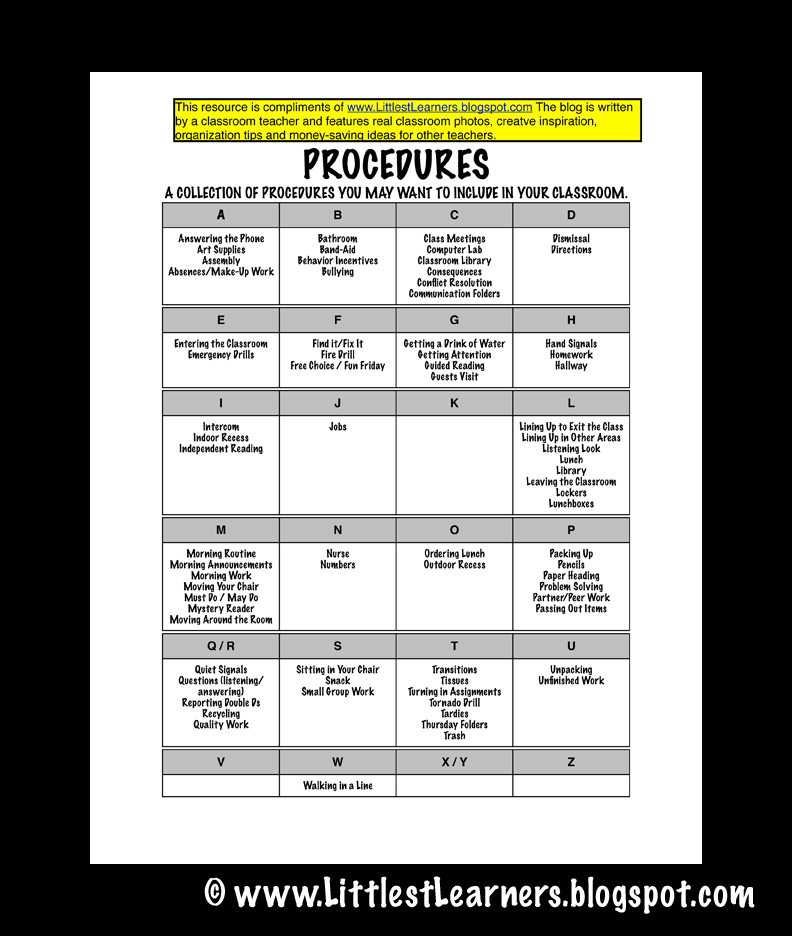
1. Brainstorm a list of all of the procedures you need to teach the children.
I've put together a few worksheets (pictured in this post) to help you. You can print them out for free at the link below. I included two sheets. One is filled with ideas I had that you may want to include. The other is blank for you to fill in with procedures you feel apply to your classroom.
2. Write out very specific instruction for each procedure. Keep the wording as simple and kid-friendly as possible.
3. Put them into an order that makes sense for you (alphabetical, by category, etc.)
4. Create a table of contents to make each specific procedure easy to reference.
5. Select the most important procedures to teach first and include them in your lesson plans for the first week.
For some of the procedures I also make a poster that can be used for the initial lesson and referenced for the first week.
Click here to print the free worksheets pictured in this post.


